
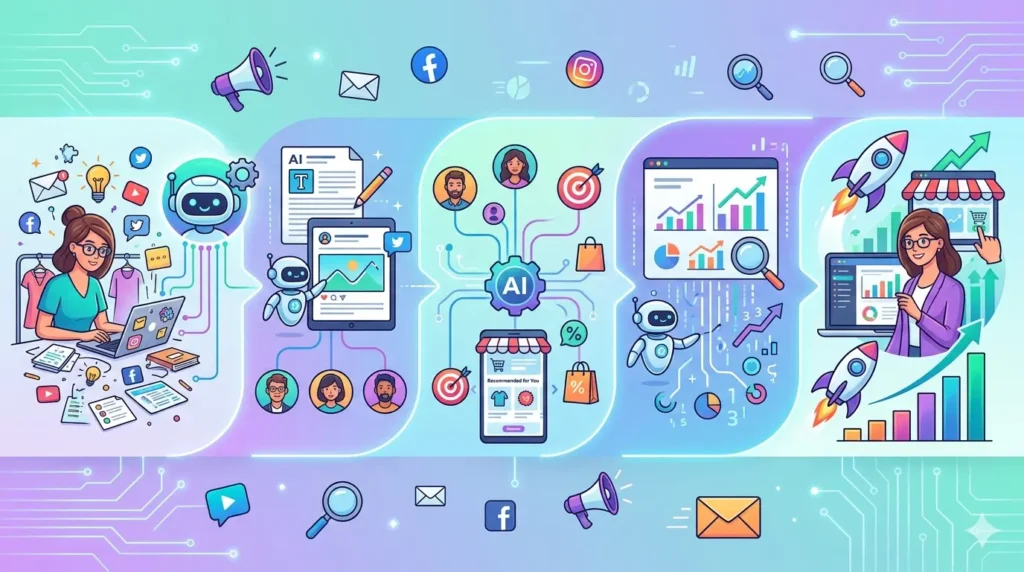
AI in marketing means using artificial intelligence tools to automate content, target customers, and analyze data without needing a developer. In 2026, affordable AI platforms make this accessible to any small business. This guide covers the best AI tools, proven strategies, real costs, and a step-by-step roadmap to get started today.
I still remember sitting across from a small business owner in 2019, a bakery owner in Austin (Texas), who told me, “Digital marketing is for the big guys. I can’t compete with companies spending $50,000 a month on ads.” I hear a version of that conversation constantly. And honestly, back then, she had a point.
But 2026 is a completely different story.
Today, that same bakery owner can use AI tools that write her Instagram captions, optimize her Google Ads bids, and even predict which customers are most likely to order again all for less than $100 a month. Some of the best tools are genuinely free.
AI has leveled the playing field for small businesses in a way nothing else has. But there’s still a lot of noise, confusion, and outright fear around it. So let’s cut through all of that.
What Is AI Marketing and Why Does It Matter for Small Businesses Right Now?
AI marketing uses artificial intelligence to automate tasks like content creation, ad targeting, and customer segmentation cutting hours of manual work down to minutes. For small businesses in 2026, it means doing more marketing with less budget, no technical expertise required.
How is AI marketing different from traditional digital marketing?
Think of traditional digital marketing like driving a car with a manual transmission. You’re in control of every gear shift every email you write, every ad you set up, every social post you schedule. It works, but it takes time and attention.
AI marketing is like having an adaptive cruise control system. You still set the destination and stay in the driver’s seat, but the system handles a lot of the moment-to-moment adjustments for you.
More specifically, traditional marketing relies on rule-based automation “send this email when someone signs up.” AI marketing learns from behavior and data. It doesn’t just follow your rules; it figures out better rules you hadn’t thought of.
Generative AI for small business: tools like ChatGPT and Claude takes this even further. These tools can create content from scratch: blog posts, ad copy, email sequences, social media calendars. That’s a fundamentally different capability than anything that existed five years ago.
What can AI actually do for a small business marketer?
Here’s where it gets practical. These are the real things AI does for small businesses today:
- Content creation: Write blog posts, email newsletters, product descriptions, and social captions in minutes instead of hours
- Ad optimization: Automatically adjust bids, audiences, and creative based on what’s performing, in real time
- Email personalization: Send different email content to different segments based on purchase history, location, or behavior
- SEO: Identify keyword opportunities, generate optimized content, and track rankings without hiring an SEO consultant
- Customer chatbots: Handle common questions 24/7 so you’re not glued to your inbox
- Analytics: Spot trends in your data that you’d never catch manually
None of this requires you to write a single line of code.
Why is 2026 the tipping point for small business AI adoption?
A few things happened between 2023 and 2026 that changed everything.
First, the tools got dramatically simpler. Early AI tools required technical setup and experimentation. Today’s platforms are designed for non-technical users drag-and-drop, fill-in-the-blank, done.
Second, the prices dropped. What cost enterprise budgets two years ago now costs $20 a month or less. A lot of the core tools are free.
Third, and this is the stat that should convince any skeptic: according to Salesforce’s State of the Small Business report, 72% of small businesses using AI report higher marketing ROI compared to those that don’t. That’s not a marginal improvement. That’s a significant competitive gap.
Small businesses not using AI in 2026 are going to feel it in their bottom line. The ones using it are already pulling ahead.
What Are the Best AI Tools for Small Business Marketing in 2026?
The best AI tools for small business marketing in 2026 include ChatGPT and Canva Magic Studio for content creation, Google Performance Max for paid ads, Buffer AI for social media, and Klaviyo AI for email. Most have free tiers you can start for $0 and upgrade as you grow.
Which AI tools are best for creating marketing content fast?
Content creation is where most small businesses feel the biggest pain and where AI delivers the fastest ROI. Here are the tools worth your time:
ChatGPT (OpenAI): The one most people have heard of. Use it to write blog posts, ad copy, email sequences, product descriptions, FAQ sections, and social captions. The free tier is genuinely powerful. For $20/month, you get GPT-4o with even better output.
Claude (Anthropic): Strong for longer, more nuanced content like detailed guides and professional emails. Particularly good at maintaining a consistent brand voice across multiple pieces of content.
Jasper: Built specifically for marketing teams. Has pre-built templates for everything from Facebook ads to full blog posts. More expensive than the others ($49+/month), but saves setup time.
Copy.ai: Great for startups and lean teams. Solid for short-form copy: social posts, taglines, subject lines. The free tier lets you create 2,000 words/month before you need to upgrade.
Real-world example: A real estate agent in Phoenix started using ChatGPT to write her property listing descriptions. What used to take 45 minutes per listing now takes under 10. She went from posting 3 listings a week to 12 and her inquiry rate went up 40% because the descriptions were more compelling than what she’d been writing herself.
What AI tools help small businesses run smarter paid ads?
Running paid ads without AI assistance in 2026 is like navigating without GPS. You might get there, but it takes longer and costs more.
Google Performance Max: Google’s AI-driven campaign type that automatically optimizes across Search, Display, YouTube, Gmail, and Maps. Feed it your assets (images, headlines, descriptions), set a budget, and the algorithm figures out the rest. Works surprisingly well for local businesses.
Meta Advantage+: Facebook and Instagram’s equivalent. Automates audience targeting, ad delivery, and budget allocation. Particularly powerful if you have any existing customer data or a pixel on your site.
AdCreative.ai: Generates ad creative (images, copy combinations) and predicts which versions will perform best before you spend a dollar. Starts at $29/month and can save significant testing costs.
Are there AI tools specifically for social media management?
Yes and this category has exploded with genuinely useful tools:
Buffer AI: Suggests post ideas, writes captions, and recommends the best times to post based on your audience’s behavior. The free plan covers up to 3 channels.
Hootsuite OwlyWriter AI: Generates social content, repurposes existing blog posts into social snippets, and can maintain a consistent publishing schedule with minimal manual input.
Canva Magic Studio: This one deserves special attention. Canva’s AI features let you generate images, resize content for different platforms, write captions, and animate graphics all without any design experience. It’s one of the most accessible tools in this entire category.
Lately: Analyzes your existing long-form content (blog posts, videos, podcasts) and automatically generates social media posts from it. Clever way to stretch what you’ve already created.
What AI tools can automate my email marketing?
Email is still the highest-ROI marketing channel for most small businesses. AI makes it dramatically more effective:
Klaviyo AI: The gold standard for e-commerce businesses. Uses purchase history and browsing behavior to automatically send the right message at the right time. Their AI features predict when each individual customer is most likely to buy.
Mailchimp Intuit Assist: Mailchimp’s built-in AI writes email subject lines, generates body copy, and even suggests send times. If you’re already on Mailchimp, you’re probably already paying for this.
ActiveCampaign: Particularly strong for service businesses. Its predictive sending feature learns when each subscriber is most likely to open, and schedules emails accordingly without any manual setup.
AI Tool Comparison: Quick Reference
| Tool | Category | Price/Month | Best For | Ease (1-5) | Free Tier? |
|---|---|---|---|---|---|
| ChatGPT | Content Creation | Free / $20 | Copy, blog posts, email | 5 | ✅ Yes |
| Claude | Content Creation | Free / $20 | Long-form, brand voice | 5 | ✅ Yes |
| Canva Magic Studio | Visual + Copy | Free / $15 | Design + social content | 5 | ✅ Yes |
| Jasper | Content Creation | $49+ | Marketing copy templates | 4 | ❌ Trial only |
| Copy.ai | Short-form Copy | Free / $49 | Ads, subject lines | 5 | ✅ Yes |
| Google Performance Max | Paid Ads | % of spend | Search + Display ads | 3 | N/A |
| Meta Advantage+ | Paid Ads | % of spend | Facebook/Instagram ads | 4 | N/A |
| AdCreative.ai | Ad Creative | $29 | Ad image + copy testing | 4 | ✅ Trial |
| Buffer AI | Social Media | Free / $15 | Scheduling + captions | 5 | ✅ Yes |
| Klaviyo AI | Email Marketing | Free / $20+ | E-commerce email | 3 | ✅ Yes |
| ActiveCampaign | Email Automation | $29 | Service business email | 3 | ❌ Trial only |
| Surfer SEO | SEO | $69 | Content optimization | 3 | ❌ No |
How Much Does AI Marketing Actually Cost a Small Business?
AI marketing can cost $0/month to start. Most major tools including ChatGPT, Canva, Buffer, and Google Analytics have genuinely useful free tiers. A realistic paid setup for a growing small business runs $50–$150/month. Enterprise-level AI stacks typically run $300–$500/month.
Is AI marketing affordable on a tight budget?
Here’s the thing most people don’t realize: you can build a genuinely effective AI marketing setup for $0. I’m not talking about barely functional tools, I mean production-quality platforms with real free tiers.
Completely free to start:
- ChatGPT (Free tier – GPT-4o mini)
- Canva (Free tier – includes Magic Studio AI features)
- Buffer (Free – up to 3 social channels)
- Google Analytics 4 – full AI-powered analytics
- Google Search Console – free SEO tracking
- Mailchimp – free up to 500 contacts
- Google Business Profile – free local SEO tool
Start there. Seriously. Get comfortable with these tools first. Most small businesses could run their entire marketing operation on free tools for 3-6 months before needing to spend a dollar.
What is a realistic AI marketing budget for a small business in 2026?
Here’s a practical breakdown of three budget tiers:
| Budget Tier | Monthly Cost | What You Get | Best For |
|---|---|---|---|
| Starter | $0/month | ChatGPT Free, Canva Free, Buffer Free, Google tools | Solopreneurs, brand-new businesses |
| Growth | $50–$150/month | ChatGPT Plus ($20) + Canva Pro ($15) + Buffer Essentials ($15) + Klaviyo ($20-50) | Established small businesses ready to scale |
| Scale | $150–$500/month | Full stack: Jasper or Copy.ai + Surfer SEO + Klaviyo mid-tier + AdCreative.ai | Growing teams, e-commerce, lead-gen businesses |
The $50–$150/month Growth tier is where most small businesses see the best return. You’re getting professional-grade tools without a large upfront commitment.
How quickly can AI tools pay for themselves through time savings?
According to McKinsey’s 2025 SMB productivity report, businesses using AI save an average of 6.4 hours per week on marketing tasks. That’s 25+ hours a month.
Let’s put that in dollars. If your time is worth $50/hour (conservative for a business owner), that’s $1,250/month in recovered time from a $100/month AI stack. The math makes sense in the first week.
One more angle: content agencies charge $500–$2,000 to write a month’s worth of blog posts and social content. AI tools, with a few hours of your own input, can produce comparable output. That’s not a small saving.
Do You Need Technical Skills to Use AI Marketing Tools?
No. The best AI marketing tools in 2026 are built for non-technical users. If you can type a message or fill out a form, you can use ChatGPT, Canva AI, or Buffer AI effectively. No coding, no setup experience, and no technical background required.
Are AI marketing tools really no-code and beginner-friendly?
I get asked this almost every week, and my honest answer is: yes, and it’s not even close.
The shift that happened between 2022 and 2025 is that the AI labs realized small businesses were their biggest untapped market. So they redesigned their interfaces specifically for non-technical users. The result is tools that feel more like consumer apps than software.
Here’s what a typical first session looks like with ChatGPT:
- Go to chat.openai.com and create a free account (2 minutes)
- Type: “Write a 200-word Instagram caption promoting my [business type] in [city] with a call to follow and a special offer”
- Read the output, tweak if needed, post
That’s it. No setup. No manuals. No IT department.
Canva’s AI works the same way describe what you want, pick from the options it generates, customize the colors and fonts, download. A first-time user can have a professional social media post ready in 15 minutes.
What’s the learning curve for popular tools like ChatGPT or Canva AI?
Shorter than you probably think. Here’s what to expect:
Day 1: Functional. You can produce usable content immediately. The first outputs might need editing, but they’re a strong starting point.
Week 1: Comfortable. You’ll have learned how to write better prompts and which tools suit which tasks. Your output quality goes up noticeably.
Month 1: Efficient. You’ll have your own workflow, saved prompts for repeated tasks, and a sense of what the AI does well versus what still needs your personal touch.
A landscaping company owner in Colorado told me she went from “I have no idea what to do with this” to running her entire social media operation solo in about two weeks. No previous marketing experience. Just showing up and experimenting.
When does a small business actually need to hire an AI specialist?
There’s a point where DIY AI hits a ceiling. Here’s a simple way to think about it:
Keep doing it yourself when:
- You’re creating content, running email campaigns, and managing social media
- Your ad spend is under $5,000/month
- You have one website or a straightforward marketing setup
- You just need content faster and smarter
Consider hiring a specialist when:
- You want custom AI integrations in your website, CRM, or e-commerce platform
- You’re running complex multi-channel ad campaigns at scale
- You want AI-powered personalization across your entire customer journey
- Your ad spend is $10,000+/month and optimization is getting technical
For most small businesses, the DIY stage can last 12–18 months before hitting that ceiling. And even then, a part-time AI marketing consultant is usually enough you don’t need a full in-house team.
How Do You Build an AI Marketing Strategy for a Small Business?
Build an AI marketing strategy by auditing your current marketing, identifying where you lose the most time, picking one or two AI tools to fix your biggest bottleneck, setting measurable goals, and scaling once your first workflow runs smoothly. Start narrow. Expand from there.
Step 1: Audit your current marketing and identify the biggest time drains
Before you open a single AI tool, spend 30 minutes answering these questions:
- Which marketing tasks take you the longest every week?
- What’s not getting done because you don’t have time?
- Where are you consistently inconsistent social media you never post on, emails you write once and forget?
- What’s your biggest bottleneck between “marketing idea” and “marketing published”?
For most small businesses, the answer is content creation. Writing takes time. Coming up with ideas takes time. That’s where to start.
Step 2: Choose 1-2 AI tools that solve your highest-priority pain point
The biggest mistake I see is tool overload. Someone discovers AI, signs up for eight tools in a weekend, gets overwhelmed, and goes back to doing everything manually.
Start with one tool. Make it the one that solves your number one problem.
- If content is your bottleneck: Start with ChatGPT or Canva
- If social media is inconsistent: Start with Buffer AI
- If your email open rates are low: Start with Mailchimp or Klaviyo
- If your ads aren’t converting: Start with Google Performance Max
Use that one tool for 30 days before adding another. Build the habit first.
Step 3: Set measurable goals and track AI’s impact on your marketing KPIs
You need to know what “working” looks like. Pick 2-3 metrics that matter for your business:
- Content output: How many blog posts, social posts, or emails per month?
- Engagement: Is your social media reach or email open rate improving?
- Leads: Are more people filling out your contact form or calling?
- Conversions: Is your website turning visitors into customers more effectively?
Track these before you start using AI. Then compare after 60 days. The numbers will tell you what’s worth investing more time in.
Step 4: Scale layer in more tools once your first AI workflow is running
Here’s a real example of how scaling works: A local restaurant in Nashville started using ChatGPT to write their weekly email newsletter in January 2025. By March, they added Buffer AI to schedule social posts from that same content. By June, they integrated Canva to create graphics for those posts. By September, they were running their entire content operation email, social, and promotions with about 4 hours of work per week.
The key was not adding the next tool until the previous one felt completely natural. One step at a time.
5 Common Myths About AI Marketing That Are Holding Small Businesses Back
This section exists because I keep seeing the same misconceptions kill momentum. Let’s deal with them directly.
Myth 1: “AI will replace my marketing team or freelancers”
Reality check: AI is not replacing strategy, creativity, or relationships. It’s replacing repetitive execution. The marketers and freelancers who are thriving in 2026 are the ones using AI to do more not the ones afraid of it.
Think of it like accounting software. QuickBooks didn’t eliminate accountants; it eliminated the tedious manual bookkeeping, freeing accountants to do higher-value advisory work. AI is doing the same thing for marketing.
If you have a marketing team or work with freelancers, AI makes them faster and more capable, not redundant.
Myth 2: “AI-generated content always hurts SEO quality”
Not true with one important caveat. Unedited, generic AI content hurts SEO because it lacks real insight, experience, or originality. But human-edited AI content that adds genuine perspective, real examples, and expert judgment performs very well.
Google’s guidance is consistent on this: they care about the quality and usefulness of content, not whether a human or AI wrote the first draft.
The winning formula in 2026 is human judgment + AI speed. You use AI to handle structure and first drafts; you add the insights, the stories, and the nuance that only you can provide.
Myth 3: “Only tech companies or big brands can afford AI tools”
We already covered the pricing above, but it bears repeating: the $0 starter stack includes tools that were enterprise-only three years ago. A plumber in rural Ohio and a Fortune 500 company are using the same underlying AI technology today. The plumber’s version just has a simpler interface.
Myth 4: “AI marketing is set-it-and-forget-it automation”
This is the one that bites people. They set up an AI tool, let it run, and wonder why results are mediocre. AI needs human oversight, refinement, and good prompting to deliver its best output.
The right mental model: AI is a very capable junior team member who needs clear direction. Give it vague instructions and you’ll get vague output. Give it specific, detailed prompts and you’ll get work you’re genuinely proud of.
Myth 5: “My industry is too niche for AI marketing to work”
I’ve seen AI marketing work for plumbers, divorce lawyers, orthodontists, specialty coffee roasters, horse trainers, and artisan pickle makers. The tools don’t care what industry you’re in they care about clear input.
In fact, niche businesses often see better results because their AI-generated content is less generic than what broader industries produce. Specific audience, specific problem, specific solution AI handles that brief very well.
Advanced AI Marketing Tips for Small Businesses Ready to Scale
Once you’ve got the basics running smoothly, these tactics separate the businesses seeing good results from the ones seeing exceptional results.
Build a customer persona library. Feed your CRM data, customer reviews, and sales call notes into ChatGPT and ask it to identify your most valuable customer segments. The output a set of detailed AI-generated customer personas gives every future piece of content a specific person to speak to.
Create a prompt library. This one is underrated. Document your best ChatGPT and Claude prompts in a shared Google Doc. When you write a prompt that produces great output, save it. Your whole team then uses consistent, tested prompts and your AI output stops varying wildly in quality.
Use AI-powered A/B testing. Tools like Mutiny and Google’s built-in website personalization let you show different landing page versions to different visitors automatically, without a developer. A healthcare clinic in Atlanta used this to increase appointment bookings by 28% without changing their ad budget.
Combine AI SEO with human editorial review. Tools like Surfer SEO or Semrush’s AI writing assistant will tell you exactly what to include in a piece of content to rank for a given keyword. But don’t just publish what they generate raw. Add your real experience, cite specific examples, and make it sound like a person actually wrote it. Because Google and your readers can tell the difference.
Frequently Asked Questions About AI Marketing for Small Businesses
FAQ 1: What is the easiest AI marketing tool for a complete beginner?
Canva Magic Studio and ChatGPT Free are the most beginner-friendly starting points. Both require zero technical knowledge. Canva handles visual content with AI prompts; ChatGPT generates copy, emails, and ad text. Most small business owners are productive within one hour of signing up.
FAQ 2: How long does it take to see results from AI marketing?
Most businesses see time savings within the first week. Measurable marketing improvements more content output, higher open rates appear within 30-60 days. Significant lead generation or revenue impact typically takes 3-6 months of consistent AI-assisted marketing activity.
FAQ 3: Is AI marketing legal does it violate advertising rules?
Yes, AI marketing is legal but disclosures are increasingly required. The FTC recommends labeling AI-generated content in ads. Always review AI outputs for accuracy, avoid fabricated claims, and check your industry’s guidelines (finance and healthcare have stricter rules).
FAQ 4: Can AI help a local service business (plumber, dentist, salon)?
Absolutely. AI tools help local businesses write Google Business Profile posts, respond to reviews, create service-area landing pages, and run targeted local ads all without a marketing agency. Local businesses often see the fastest ROI because AI directly reduces their biggest bottleneck: content creation time.
FAQ 5: What AI marketing trends should small businesses prepare for in 2026?
Key 2026 trends: AI-powered search (Google SGE and ChatGPT Search) requiring AEO-optimized content; voice search growth; hyper-personalized email at scale; AI video generation for social media; and autonomous marketing agents that execute full campaigns from a single prompt.
The Bottom Line: Is AI Worth It for Your Small Business?
Here’s my honest take after 20 years in this industry: AI is not a magic wand. It won’t fix a bad product, a confusing offer, or a website nobody trusts. Those fundamentals still matter.
But if your fundamentals are solid and you’re just outgunned by larger competitors on content volume, ad optimization, or time — AI genuinely closes that gap. The bakery owner in Austin I mentioned at the start? She’d have a completely different business today if these tools had existed in 2019.
They exist now. The question is just whether you’ll use them.
Start with the free tools. Pick one problem to solve. Give it 30 days. The results will convince you faster than anything I can write here.
Sources: Salesforce State of the Small Business Report 2025; McKinsey AI Productivity Study 2025; HubSpot SMB Marketing Trends Report 2025; Forbes Small Business AI Survey 2025