
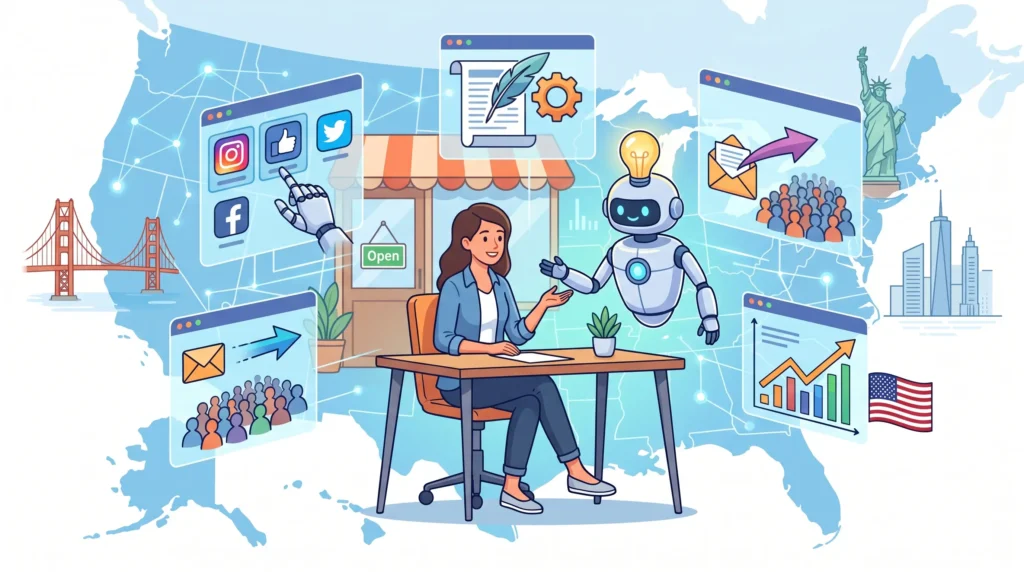
The best AI marketing tools for small businesses in the USA include Jasper AI for content creation, HubSpot for CRM automation, Canva Magic Studio for design, and Surfer SEO for search optimization, among others. These tools help small business owners compete with larger brands. They reduce manual workload and help you grow faster without hiring a full marketing team. This guide breaks down the top 10 options, including pricing, features, and who each tool is best for.
According to Salesforce’s 10th State of Marketing Report, 75% of marketers are already using AI in some form — and SMBs using it are pulling ahead. If your competitors are using AI and you are not, you are already behind.
Why Should Small Business Owners in the USA Care About AI Marketing Tools Right Now?
AI in marketing is no longer just for big companies with large budgets. Tools are now affordable, easy to set up, and require zero coding skills. The shift happened fast, and small businesses that move now have a real edge.
How Is AI Actually Changing Small Business Marketing in 2025?
A few years ago, AI marketing tools were clunky and expensive. Today, they are no-code, subscription-based, and built for small teams. Here is what has changed:
AI now writes your blog posts and ad copy. It sends emails at the exact right time for each subscriber. It answers customer questions at 2 AM without anyone on your team being awake. It tracks your competitors’ keywords and tells you exactly what to write next.
Small businesses using AI consistently report cutting 30 to 40 percent of the time they used to spend on repetitive marketing tasks. That time goes back into running the business.
What Criteria Did We Use to Rank These AI Marketing Tools for Small Businesses?
Not every tool that calls itself “AI-powered” actually delivers results for small businesses. Here is what we looked at when building this list:
Ease of use: No developer needed. You should be up and running in under an hour.
Affordable pricing: A free tier or a starting price under $100 per month. Budget is the number one constraint for most small businesses.
Proven, measurable output: The tool must help you produce results you can track, such as more leads, better open rates, or higher search rankings.
Integration with tools you already use: WordPress, Shopify, Gmail, and Google Analytics. The tool must fit into your existing workflow.
US-market relevance: Support, compliance, and audience targeting features built for the US market.
Active development: Tools that keep improving are worth your money. Tools that stopped updating in 2022 are not.
What Are the 10 Best AI Marketing Tools for Small Businesses in the USA?
Here is a quick overview of all 10 tools before we go deep on each one.
| # | Tool | Primary Function | Pricing | Best Use Case |
|---|---|---|---|---|
| #1 | Jasper AI | AI content writing | From $39/mo | Blog and ad copy |
| #2 | HubSpot AI | CRM and marketing automation | Free tier + paid | All-in-one CRM |
| #3 | Canva Magic Studio | AI design and visuals | Free + $15/mo Pro | Social graphics |
| #4 | Mailchimp + AI | AI email marketing | Free tier + paid | Email campaigns |
| #5 | Surfer SEO | AI SEO optimization | From $89/mo | Blog SEO |
| #6 | Hootsuite OwlyWriter AI | AI social media management | From $99/mo | Social scheduling |
| #7 | ChatGPT (GPT-4o) | AI writing and strategy | Free + $20/mo Plus | Multi-use AI |
| #8 | Semrush AI | AI SEO and competitor analysis | From $130/mo | SEO and PPC |
| #9 | Tidio AI Chatbot | AI live chat and lead gen | Free + $29/mo | Website lead capture |
| #10 | AdCreative.ai | AI ad creative generation | From $29/mo | Paid ad creatives |
#1: Is Jasper AI the Best AI Writing Tool for Small Business Content Marketing?
What it does: Jasper writes blog posts, ads, emails, social captions, and product descriptions.
Best for: Business owners who need a lot of written content but have no content team.
Key AI features: Over 50 templates, Brand Voice training so Jasper learns your tone, a built-in Jasper Chat, and an SEO mode that connects directly with Surfer SEO.
Pricing: Starts at $39 per month for the Creator plan. No free tier, but a 7-day trial is available.
Real-world use case: A Denver-based HVAC company uses Jasper to publish four SEO blog posts every month. Their content costs dropped 60 percent compared to what they previously paid freelance writers.
Pro: Produces a strong first draft in minutes for almost any content format.
Con: Requires human editing. Jasper gives you a first draft, not a final one. Brand voice accuracy needs regular review.
#2: Can HubSpot’s AI Features Replace a Full Marketing Team for a Small Business?
What it does: HubSpot combines a CRM, email marketing automation, landing page builder, and lead scoring in one platform.
Best for: Service businesses that want to automate their sales funnel from lead capture all the way to close.
Key AI features: AI email writer, predictive lead scoring, ChatSpot (an AI assistant that works inside your CRM), and a content remix tool.
Pricing: Free CRM tier available. Marketing Hub starts at $18 per month. Costs rise significantly as your contact list grows.
Real-world use case: A Dallas real estate agency uses HubSpot AI to automatically qualify new leads and send personalized follow-up email sequences. They saved five hours per week on manual outreach.
Pro: One platform replaces four or five separate tools. This cuts down on tool switching and reduces confusion.
Con: Pricing scales steeply with contact list size. What starts at $18 per month can grow fast if your list does.
#3: Is Canva Magic Studio the Best AI Design Tool for Small Business Social Media?
What it does: Canva creates graphics, videos, presentations, and branded marketing materials using AI.
Best for: Business owners who need professional visuals but have no graphic designer on staff.
Key AI features: Magic Write for AI-generated copy, Magic Design for AI-suggested layouts, Background Remover, Text-to-Image, and Magic Edit for photo adjustments.
Pricing: Free tier is robust and suitable for most small businesses. Canva Pro costs $15 per month per user.
Real-world use case: A Chicago bakery uses Canva Magic Studio to create all their social media graphics, packaging mockups, and promotional flyers. Their design budget is zero.
Pro: Lowest learning curve of any design tool on this list. Non-designers consistently produce professional-looking results.
Con: Templates can look repetitive over time. Extra effort is needed to make your brand stand out from other Canva users.
#4: Does Mailchimp’s AI Actually Improve Email Marketing Results for Small Businesses?
What it does: Mailchimp creates email campaigns, automates sequences, segments your audience, and optimizes send times using AI.
Best for: Small businesses with an email list of any size who want to automate their customer communication.
Key AI features: Content Optimizer, Predicted Demographics, Send Time Optimization, and a Subject Line Helper that suggests better-performing options.
Pricing: Free up to 500 contacts. Essentials plan starts at $13 per month and scales with your list size.
Real-world use case: A Seattle boutique used Mailchimp’s Send Time Optimization to increase their email open rates by 22 percent. They changed nothing in the email itself — only the send time.
Pro: The free tier is one of the best starting points in the email marketing space.
Con: Automation workflows are less powerful than HubSpot or ActiveCampaign when you are managing complex sequences at scale.
Email marketing is worth taking seriously. According to Litmus, email delivers an average return of $36 for every $1 spent, making it the highest-ROI channel in digital marketing. Even a basic setup pays off quickly.
#5: Is Surfer SEO Worth It for a Small Business Trying to Rank on Google?
What it does: Surfer SEO analyzes top-ranking pages and gives you real-time writing guidance to match what Google wants to see.
Best for: Small businesses publishing blog content who want data-driven SEO without paying for an agency.
Key AI features: Content Score, Outline Builder, NLP-powered keyword clusters, and Surfer AI for generating full drafts optimized for search.
Pricing: Starts at $89 per month for the Essential plan. No free tier, but a free Chrome extension is available.
Real-world use case: An Austin law firm used Surfer SEO to optimize 12 existing blog posts. Six of those posts moved to Page 1 of Google within 10 weeks, without building a single new backlink.
Pro: Actionable SEO recommendations you can apply while you write. No guesswork involved.
Con: Higher price point for solo operators. The ROI depends on publishing consistently — Surfer works best when you are putting out content regularly.
#6: Which AI Social Media Tool Saves the Most Time for Small Business Owners?
What it does: Hootsuite manages scheduling, content creation, and analytics across all major social platforms.
Best for: Small businesses running three or more social channels who need automated scheduling and AI caption writing.
Key AI features: OwlyWriter AI for captions and hashtag suggestions, a best-time-to-post AI, and AI-powered response suggestions for comments.
Pricing: Starts at $99 per month. Higher entry point, but a free trial is available.
Real-world use case: A Miami salon cut their social media management time from eight hours per week to under two hours. Hootsuite AI handles scheduling and caption creation automatically.
Pro: Best-in-class social media management with strong AI built in.
Con: The price point is a barrier for very early-stage businesses. Buffer or Later are more affordable alternatives if you are just getting started.
#7: How Can Small Business Owners Use ChatGPT to Market Their Business?
What it does: ChatGPT handles writing, strategy, market research, ad copy, email drafts, social content, and customer service scripting.
Best for: Business owners who want one tool that does a little of everything.
Key AI features: GPT-4o multimodal (text plus image analysis), Custom GPTs you can train for your business, real-time browsing, and a code interpreter.
Pricing: Free tier uses GPT-3.5. ChatGPT Plus costs $20 per month and unlocks GPT-4o with all advanced tools.
Real-world use case: A Nashville food truck owner uses ChatGPT to write weekly Instagram captions, customer email replies, Yelp responses, and monthly promotional offers. It takes him under 30 minutes per week.
Pro: The most versatile tool on this list. It effectively replaces five or six single-purpose tools for creative tasks.
Con: Requires good prompting skills to get consistent, high-quality output. There are no built-in publishing integrations, so you always need to copy and paste to your platforms.
This is the most commonly searched AI tool for small business marketing. If you are new to AI and want one place to start, ChatGPT Plus at $20 per month is the logical first step.
#8: Is Semrush AI Worth the Cost for a Small Business SEO Strategy?
What it does: Semrush covers SEO audits, keyword research, competitor analysis, content marketing, and PPC research in one platform.
Best for: Growth-stage small businesses serious about organic search and competitive intelligence.
Key AI features: AI Writing Assistant, ContentShake AI for topic and content generation, keyword magic tool with AI clustering, and AI-powered site audit recommendations.
Pricing: Starts at $130 per month. Premium pricing, but a 7-day free trial is available.
Real-world use case: A Boston e-commerce store found three competitor keyword gaps using Semrush AI. They created five targeted blog posts targeting those gaps and captured 1,200 new monthly organic visitors within three months.
Pro: The most comprehensive SEO and content intelligence platform a small business can access.
Con: Expensive for early-stage businesses. Best value when you are already publishing content consistently and want to scale it.
#9: Can an AI Chatbot Actually Generate Leads for a Small Business Website?
What it does: Tidio AI combines live chat, chatbot automation, email and SMS marketing, and visitor tracking in one tool.
Best for: E-commerce and service businesses that get website traffic but fail to capture those visitors as leads.
Key AI features: Lyro AI for conversational customer chats, AI ticketing, intent detection to identify buying signals, and a product recommendation engine.
Pricing: Free up to 50 AI conversations per month. Paid plans start at $29 per month.
Real-world use case: A Portland home services business added Tidio AI to their website and captured over 40 new quote requests per month from visitors who previously left without making contact.
Pro: Turns passive website visitors into active leads. This directly solves the “traffic but no conversions” problem that plagues many small business websites.
Con: AI responses can occasionally mishandle complex service questions. Human handoff rules need careful setup to avoid frustrating potential customers.
#10: What Is the Best AI Tool for Creating Small Business Facebook and Google Ads?
What it does: AdCreative.ai generates ad images, banners, and video thumbnails optimized for conversion using real advertising performance data.
Best for: Small businesses running paid ads who struggle with producing enough creative variations to test properly.
Key AI features: AI creative generation directly from your product URL, a competitor ad spy feature, conversion score prediction, and dynamic A/B testing.
Pricing: Starts at $29 per month for the Starter plan. A free trial is available.
Real-world use case: A Phoenix fitness studio used AdCreative.ai to test 15 ad creative variations in a single week. They found a winning creative that cut their cost-per-lead by 34 percent.
Pro: Solves the creative bottleneck problem for paid ad campaigns. It effectively replaces a graphic designer for ad production.
Con: Best results require connecting your Meta Ads or Google Ads accounts so the tool can use real performance data to improve its suggestions.
How Do I Know Which AI Marketing Tool Is Right for My Small Business?
This is the question that matters most. Picking the wrong tool wastes money and time. Here is how to choose correctly.
Should I Use One AI Marketing Tool or Build a Stack of Multiple Tools?
Start with one tool that solves your biggest marketing problem. Do not buy five tools in the first month. Most small businesses do best with a three-tool core stack: one AI content tool, one AI SEO or distribution tool, and one AI email or CRM tool.
Only add a second tool once you have seen clear results from the first.
Recommended starter stacks:
Solo operator: ChatGPT Plus ($20) + Canva Pro ($15) + Mailchimp Free = $35 per month total.
Small team of 3 to 10 people: Jasper ($39) + Surfer SEO ($89) + HubSpot Free = $128 per month total.
If you are unsure which stack makes sense for your specific business model, our team at Upsollo can help you map the right tools to your actual goals before you spend a dollar.
What Is the Best Free AI Marketing Tool for a Small Business Just Starting Out?
The best free AI tools for small businesses are ChatGPT Free, Canva Free, Mailchimp Free (up to 500 contacts), Tidio Free (up to 50 AI chats per month), and Google Analytics 4.
This free stack is powerful enough for businesses under $250K in annual revenue. Start with these tools, build a routine around them, and upgrade only after you have seen consistent results. Paying for multiple AI tools before you have a publishing and marketing routine is the most common waste we see small businesses make.
How Do I Measure the ROI of an AI Marketing Tool for My Small Business?
Track the following metrics before and after you introduce any AI tool:
Time saved per week: Log your hours before and after adopting the tool. A good tool saves at least three to five hours per week minimum.
Content output volume: Track how many posts or emails you publish per month. Two times your pre-AI output is a reasonable target within 60 days.
Organic traffic growth: Use Google Search Console and Google Analytics 4. A 10 to 20 percent growth in three to six months is realistic for SEO tools.
Email open and click rates: Your email tool’s dashboard shows this. Industry average open rates sit between 20 and 25 percent for most small businesses.
Lead conversion rate: Track in your CRM. A 5 to 15 percent improvement within 90 days is a meaningful result.
Cost per lead from paid ads: Pulled from your Meta Ads or Google Ads dashboard. A 10 to 30 percent reduction is achievable with AI creative testing.
Where Should a Small Business Start With AI Marketing Tools, and in What Order?
Use this priority matrix to decide which tool category to tackle first, based on your current marketing situation.
| AI Tool Category | Setup Difficulty | Marketing Impact | Time to See Results |
|---|---|---|---|
| AI content tools (Jasper, ChatGPT) | Low | Very High | Immediate |
| AI SEO tools (Surfer, Semrush AI) | Medium | Very High | 4 to 12 weeks |
| AI email marketing (Mailchimp AI) | Low | High | 2 to 4 weeks |
| AI social media tools (Hootsuite AI) | Low | High | Immediate |
| AI design tools (Canva Magic) | Low | High | Immediate |
| AI CRM (HubSpot AI) | Medium | Very High | 1 to 3 months |
| AI chatbots (Tidio) | Low to Medium | High | 1 to 2 weeks |
| AI ad creatives (AdCreative.ai) | Low | High | Immediate |
Step-by-Step: How to Implement Your First AI Marketing Tool in 7 Days
Day 1 to 2: Identify your single biggest marketing bottleneck. Is it content? Leads? Social media? Email? Name the one thing that is costing you the most time or money right now.
Day 2: Sign up for the free tier or free trial of the tool that directly solves that problem. Only one tool.
Day 3 to 4: Complete the onboarding. Connect it to your website, CRM, or social accounts.
Day 5: Produce your first piece of AI-assisted content or your first automated workflow.
Day 6: Set your baseline metrics in Google Analytics 4 so you have a before number to compare against.
Day 7: Schedule a 30-day check-in. Measure results before you decide to upgrade or add a second tool.
This seven-day approach keeps you from getting overwhelmed. One tool, one problem, one month of data. That is all you need before making your next decision.
What Do Small Business Owners Get Wrong About AI Marketing Tools?
These three beliefs lead to poor results more than any other factor.
“AI Tools Will Replace My Marketing Entirely” Why This Leads to Poor Results
AI tools are force multipliers, not replacements. They amplify what a skilled person already does. Unsupervised AI output lacks brand voice, local nuance, and strategic judgment. The businesses getting the best results from AI follow a simple model: the AI produces the first draft, and the human refines and publishes it. That combination is what wins.
“The Most Expensive AI Tool Must Be the Best One” The Feature Trap
Semrush at $130 per month is not better than ChatGPT at $20 per month for a business that primarily needs content help. The tool needs to match the specific problem you are trying to solve. Over-investing in AI SEO tools before you have a consistent content publishing schedule is one of the most common and costly mistakes we see. Start with the tool that addresses your top revenue-blocking problem, not the tool with the longest feature list.
“I Tried AI Marketing for One Month and It Didn’t Work” The Timeline Misconception
SEO tools like Surfer SEO and Semrush need three to six months to show measurable ranking improvements. That is not a tool failure; that is how Google works. Email and conversion tools can show results in two to four weeks. Content and social tools deliver value almost immediately. AI marketing is a compounding investment. The results improve steadily as the AI learns your brand voice and your audience’s behavior patterns.
“AI Content Is Automatically Penalized by Google” The SEO Myth Costing Businesses Traffic
Google has been clear on this point: it rewards helpful, high-quality content regardless of how it was created. What Google penalizes is low-quality, unedited, mass-produced content that provides no real value. AI-assisted content that a human has reviewed, fact-checked, and refined to match their brand voice is fully compliant with Google’s helpful content guidelines. Use AI to draft and structure. Use your judgment to edit, add examples, and make it genuinely useful.
FAQ About AI Marketing Tools for Small Businesses
FAQ 1: What Is the Best AI Marketing Tool for a Small Business With a Limited Budget?
For small businesses on a tight budget, ChatGPT Plus at $20 per month is the single most versatile AI marketing tool available. It handles content creation, email writing, social media captions, ad copy, and customer service scripting across every format. Pair it with Canva Free for design and Mailchimp Free for email and you have a complete AI marketing stack for under $25 per month. That combination covers the three most time-consuming marketing tasks for most small business owners without requiring a significant financial commitment.
FAQ 2: Are AI Marketing Tools Safe for Small Businesses to Use With Customer Data?
Reputable AI marketing tools, including HubSpot, Mailchimp, Canva, and Jasper, are GDPR and CCPA compliant and publish clear data processing agreements. For US-based small businesses, the key precautions are: avoid entering personally identifiable customer data into general-purpose AI tools like ChatGPT unless you have a business API agreement in place, and always review the privacy policy of any tool before connecting it to your CRM or email list. Most of the tools on this list have explicit data protection commitments designed for business use.
FAQ 3: How Much Do AI Marketing Tools Cost for a Small Business?
The range is wide depending on what you need. A free-only stack using ChatGPT Free, Canva Free, and Mailchimp Free costs $0 per month and is suitable for businesses just getting started. An entry-level stack combining ChatGPT Plus, Canva Pro, and Mailchimp Essentials runs $55 to $80 per month and works well for solopreneurs. A mid-tier stack of Jasper, Surfer SEO, and Hootsuite AI costs $250 to $350 per month and is strong for teams of one to ten people. A full growth-stage suite combining HubSpot, Semrush, AdCreative.ai, and Jasper runs $400 to $700 per month and is best for businesses actively scaling their marketing.
FAQ 4: Can AI Marketing Tools Help My Small Business Rank Higher on Google?
Yes, specifically, AI SEO tools like Surfer SEO, Semrush AI, and ChatGPT used for content ideation and on-page optimization directly support higher Google rankings when used consistently. They help you identify the right keywords, match search intent, and structure content the way top-ranking pages are structured. The important caveat is consistency. One AI-optimized article per month published on a regular schedule will outperform ten unoptimized articles published sporadically. The tool gives you the edge; your publishing cadence determines whether that edge compounds over time.
FAQ 5: What Is the Difference Between AI Marketing Tools and Traditional Marketing Software?
Traditional marketing software automates fixed, rule-based tasks. For example, it sends a welcome email whenever someone joins your list. AI marketing tools go further by generating original content, predicting the best send time for each individual subscriber, writing multiple ad copy variations, and scoring leads based on behavioral patterns rather than just form submissions. The practical difference is that AI tools improve over time as they process more data about your audience, while traditional software performs the same fixed function regardless of how your results change.
What Is the Best First Step for a Small Business Ready to Use AI Marketing Tools?
You do not need all 10 tools on this list. You need the one tool that directly solves your biggest marketing bottleneck today.
If content creation is eating your time, start with ChatGPT Plus or Jasper AI. If your email list is sitting unused, start with Mailchimp’s free AI features. If you need social media content but have no time to create it, start with Canva Pro and Hootsuite AI.
The three highest-impact categories to start with are AI content tools, AI email tools, and AI design tools. Together they cover the work that consumes the most time for most small businesses, and they are all available at a low cost or free.
The playing field has shifted. AI marketing tools are no longer exclusive to companies with large marketing departments and agency budgets. A solo operator with the right three tools can now out-publish, out-email, and out-design a competitor with a full in-house team who is not using AI at all.
That is the window of opportunity that exists right now. The businesses that move in the next six months will be the ones that benefit most from it.
Salesforce’s own SMB research shows that 78% of SMB marketers now trust AI to handle customer inquiries. The comfort level with AI is rising fast, and the businesses adopting it early are building compounding advantages.
If you are not sure where to start or which tools make the most sense for your specific business model, our team at Upsollo works with small businesses to build practical, affordable AI marketing stacks. We cut through the noise and help you pick tools that match your goals, not just tools that sound impressive in a demo.
Start with one tool. Give it 30 days. Measure the results. Then build from there.